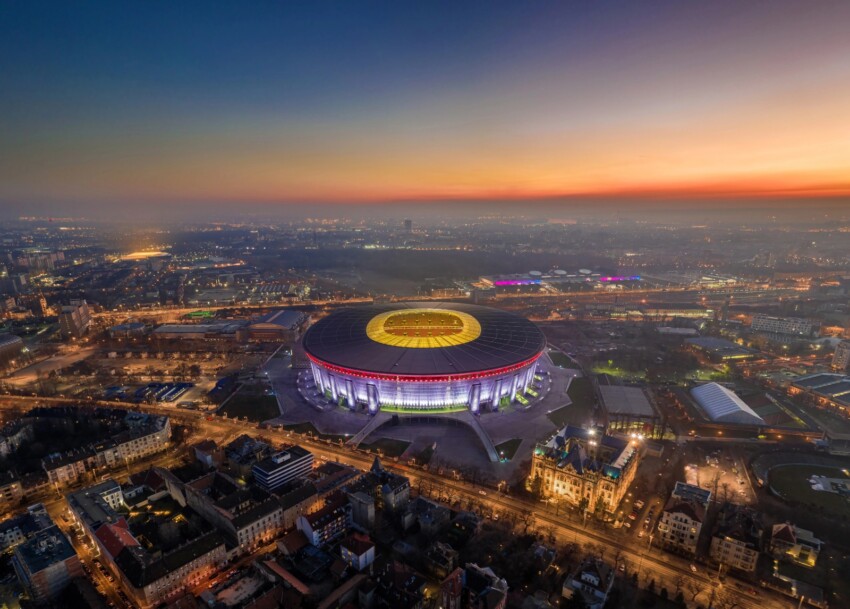
With a capacity of 67,889 seats and a design inspired by classic European stadiums of the twentieth century, Puskás Aréna is Hungary’s largest stadium and one of the continent’s most modern football facilities. Inaugurated in November 2019 and named after the legendary Hungarian striker Ferenc Puskás, the arena stands on the exact site of the old Nép Stadium – the Palace of the People – which for decades had been the beating heart of Hungarian football.
The stadium is located in Budapest’s XIV district, in the Zugló neighbourhood, approximately 3 km from the city centre and easily accessible by metro and public transport. Its strategic position, nestled in a green area and close to the historic Városliget (the city park), makes it an interesting destination even for those who aren’t football enthusiasts. In 2026, Puskás Aréna will host the UEFA Champions League final, an event that will place Budapest at the centre of global football attention.
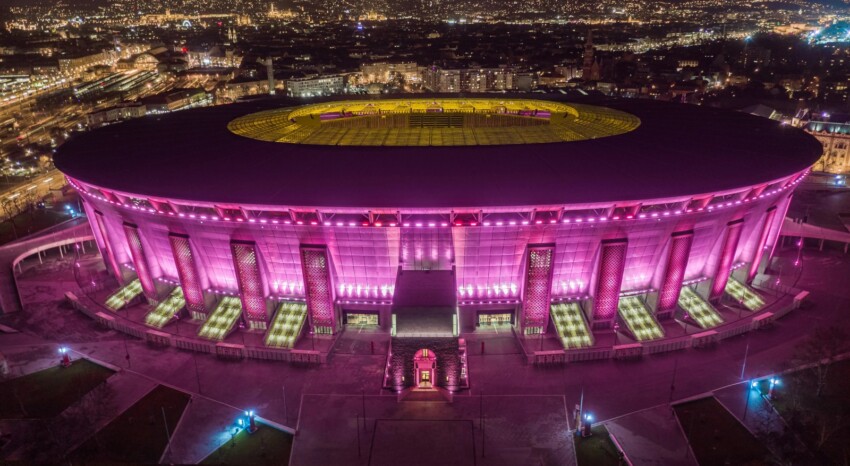
Your first encounter with Puskás Aréna is already a spectacle. The architectural firm Északi Sportcentrum has designed a structure that deliberately pays homage to Europe’s great stadiums of the 1950s and 1960s, with colonnades, arches and red-brick cladding that echo the aesthetic of the old Nép Stadium. Yet everything is new, meticulously calculated and technologically advanced: the façade is a thoughtful blend of tradition and modernity.
Walking around the external perimeter, you’ll notice statues dedicated to the greats of Hungarian football, including a bronze statue of Puskás himself, with his distinctive left-footed strike. The area surrounding the stadium has been revitalised with plazas, flowerbeds and pedestrian spaces: even without going inside, it’s worth stopping to explore the exterior.
The facility is entirely covered by a steel and ETFE roof that protects all 67,889 seats without impeding the natural growth of the grass pitch, thanks to a sophisticated artificial lighting system. The proximity of the stands to the pitch – the nearest edge is just 7 metres from the grass – guarantees an electric atmosphere during matches.
The seats are arranged on three tiered rings and visibility is excellent from any section. During guided tours, you can sit in the VIP stands and hospitality area armchairs, which during the 2026 Champions final will host UEFA top brass and senior executives from Europe’s leading clubs.
Inside the stadium is the Ferenc Puskás Museum, a permanent exhibition space that traces the career of the legendary “Galloping Major”, who scored 84 goals in 85 matches for the Hungarian national team. The museum houses original kits, trophies, archive footage and personal memorabilia of Budapest’s ace, who also played for Real Madrid, winning three consecutive European Cups between 1958 and 1960.
Adjacent to the museum is the Hall of Fame of Hungarian football, with panels dedicated to the protagonists of the golden team of the 1950s – the side that destroyed England 6-3 at Wembley in 1953, ending 90 years of English home invincibility. Essential reading to understand the historical weight of the Hungarian nation in European football.
The arena is divided into well-marked sections, with an east stand dedicated to away supporters on match days. The second-tier seats offer a privileged view of the entire playing surface, whilst the third-tier seats, though further away, allow you to take in the entire stadium bowl in one sweeping gaze.
During tours, Puskás Aréna staff guide visitors through the tunnels leading to the dressing rooms, where you can experience first-hand the quality of the facilities: from integrated thermal baths to muscle recovery areas, everything reflects the highest UEFA standards for European competitions.
The site on which Puskás Aréna now stands has a sporting history dating back to 1953, when the old Nép Stadium (literally “People’s Stadium”) was inaugurated. At the time, it was one of Europe’s most capacious facilities, with over 100,000 seats. It was on this pitch that the Hungarian national football team wrote some of its most glorious pages, including the celebrated 6-3 friendly victory against England.
Over the decades, Nép Stadium gradually deteriorated, and in 2016 the Hungarian authorities decided to demolish it and build a completely new facility in its place, capable of meeting the requirements for UEFA Category 4 competitions – the highest category approved for hosting international finals. The work, carried out by a consortium of Hungarian builders, took just over three years and cost approximately 600 million euros.
Puskás Aréna was inaugurated on 15 November 2019 with an international friendly between Hungary and Uruguay, won by the Hungarians 2-1. Since then it has hosted Champions League matches, Europa League matches, the UEFA Nations League and some matches from Euro 2021, which took place across multiple European venues during the pandemic. In 2026, it will reach the pinnacle of its sporting history by hosting the UEFA Champions League final.
Puskás Aréna offers various types of guided tour, with prices varying according to the route chosen. The standard tour lasts approximately 60-75 minutes and includes access to the pitch, dressing rooms, press stand and the Puskás Museum. There is also a premium tour, more comprehensive, which adds access to the VIP lounges and hospitality areas normally reserved for sponsors.
For Hungarian national team matches and UEFA events, tickets are released through separate channels specified each time by the Hungarian Football Federation (MLSZ).
For the 2026 Champions League final, tickets are distributed by UEFA through its ballot system reserved for UEFA.com subscribers: it’s advisable to register in advance on the official portal to avoid missing the draw entry window.
Puskás Aréna guided tours generally run every day with departures every 30-60 minutes, except on match days or special events. Hours vary seasonally: in summer (June-August), visits typically run from 10:00 to 18:00, whilst in winter the last tour departs around 16:00. It’s always advisable to check the updated schedule on the official website before planning your visit.
For a standard tour of the museum and dressing rooms, approximately 90 minutes is sufficient. Those who wish to take their time exploring all the exhibition halls and viewing points should allow at least two hours. The best time to visit the stadium without crowds is weekday mornings, away from weeks of major international events.
The stadium is located in Budapest’s XIV district, at Stefánia út 3-5, easily accessible by public transport operated by BKK Budapest.
The most convenient option is the M2 metro line (red line), with a stop at Puskás Ferenc Stadion directly beneath the facility: from Deák Ferenc tér station, the heart of downtown Budapest, the journey takes just 7 minutes. Alternatively, numerous bus and tram lines connect the stadium area with the rest of the city.
By taxi or ridesharing services such as Bolt or FREE NOW (the most popular apps in Budapest), the journey from the historic centre takes approximately 10-15 minutes depending on traffic. The estimated cost from Vörösmarty tér area is €4-6.
Those arriving by car will find parking on the streets surrounding the stadium, although on match days or major events, availability is drastically reduced. The best solution in these cases remains the metro.
City Card allow you to save on public transport and / or on the entrances to the main tourist attractions.



 Hotel
Hotel  Budget accommodations
  Apartments
  Family Hotel
  Luxury Hotel