Science Hotel
Szeged - Petőfi Sándor sgt. 17.
Book now
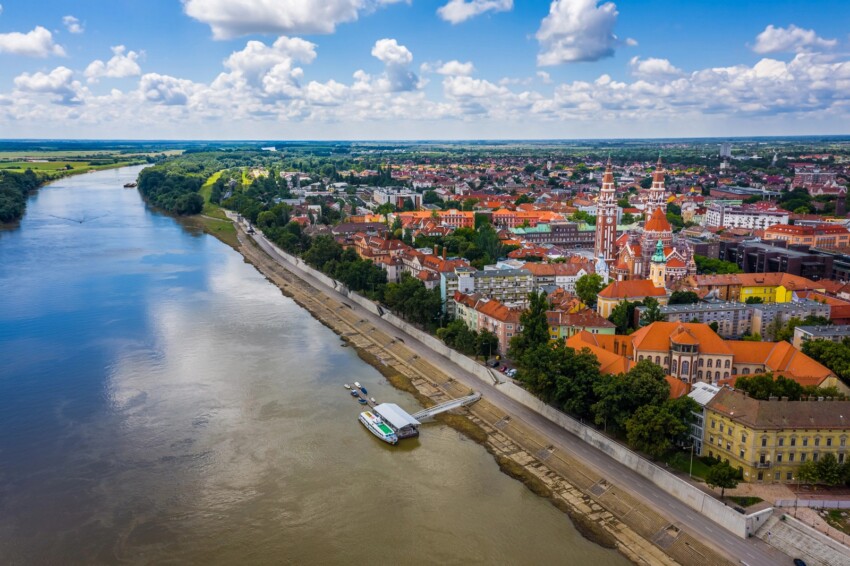
Szeged is Hungary’s third largest city with a population of 161,000, located in the far south of the country on the banks of the Tisza River, just 10 kilometres from the border with Serbia. Known as the ‘City of Sunshine’ due to its particularly favourable climate that guarantees more than 2,100 hours of sunshine per year, Szeged boasts elegant architecture and tree-lined boulevards that give it a refined Central European atmosphere, comparable to that of Vienna or Budapest.
The city’s modern history began symbolically in 1879, when a devastating flood of the Tisza destroyed 95 per cent of the buildings, killing more than 150 people. Reconstruction, led by international architects and financed by numerous European nations, transformed Szeged into a modern city with wide boulevards and beautiful Art Nouveau buildings. This urban renaissance is still visible today in the historical centre, where every corner tells of the city’s gratitude to the nations that contributed to the reconstruction: streets bear names such as Londoni körút, Bécsi körút or Brüsszeli körút.
Szeged is world-famous for the production of Szeged paprika, a spice with a characteristic bright red colour that has been awarded the protected designation of origin PDO by the European Union. The local variety, cultivated in the surrounding sandy plains for more than 400 years, is considered the best in the world and is a key ingredient in Hungarian cuisine. The paprika museum and the covered market where you can buy paprika directly from the producers are must-sees for gastronomy enthusiasts.
The city is also home to one of Hungary’s most prestigious universities, founded in 1581, which attracts over 30,000 students and gives Szeged a lively and cosmopolitan atmosphere. The university centre is the birthplace of world-famous personalities such as Albert Szent-Györgyi, who won the Nobel Prize in Medicine in 1937 for the discovery of vitamin C.
Szeged offers a fascinating combination of historical monuments, Art Nouveau architecture, specialised museums and unique gastronomic traditions. The city can be explored comfortably on foot thanks to its compact and well-organised centre, with the main attractions concentrated within a few kilometres. A walk along the Tisza at sunset, when the cathedral lights up creating striking reflections on the water, is one of the most memorable moments of the visit.
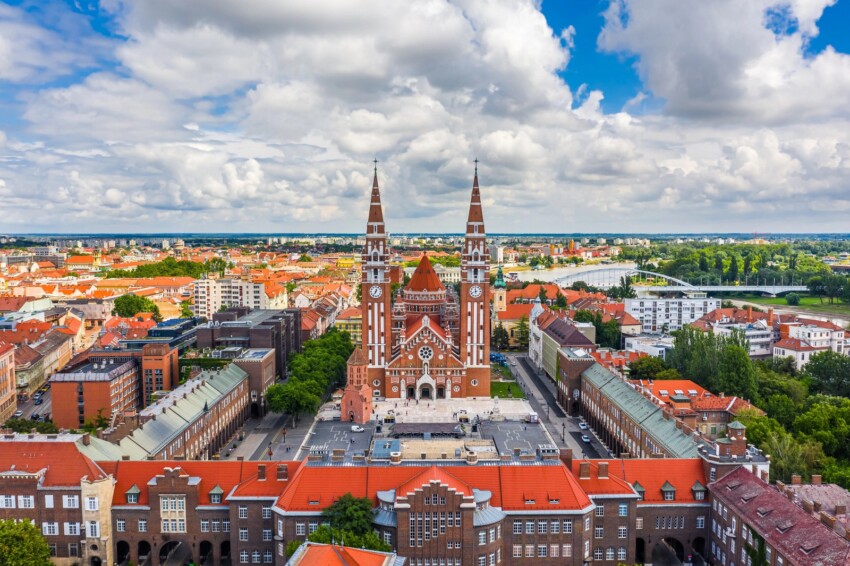
The Fogadalmi templom dominates the skyline of Szeged with its twin 91-metre high towers and is one of the most impressive examples of neo-Romanesque architecture in Hungary. Built between 1913 and 1930 to a design by architect Frigyes Schulek (the same as the Matthias Church in Budapest), the cathedral was erected as a vow of the city after the devastating flood of 1879. The main façade features a monumental portal decorated with polychrome mosaics depicting biblical scenes, made by the Venetian Salviati manufacture.
The interior, capable of accommodating up to 5,000 worshippers, has three naves with a total length of 81 metres. The most spectacular element is the monumental organ built by the Angster company in 1930, which has 9,040 pipes and is considered one of the largest instruments in Central Europe. During the summer, organ concerts are organised every Thursday evening at 8:30 p.m., with admission charge of 2,000 guilders. The stained glass windows, which were damaged during the Second World War, were replaced in the 1970s with modern stained glass windows of abstract design that create striking lighting effects.
The underground crypt houses the Pantheon of Famous Hungarians, a gallery of statues and busts honouring national personalities from culture, science and politics. Visiting the cathedral is free of charge, but access to the viewing tower (open from April to October) requires a ticket of 800 forints. The 291 steps lead to a platform from which there is an exceptional view of the city and the Tisza plain stretching to the horizon.
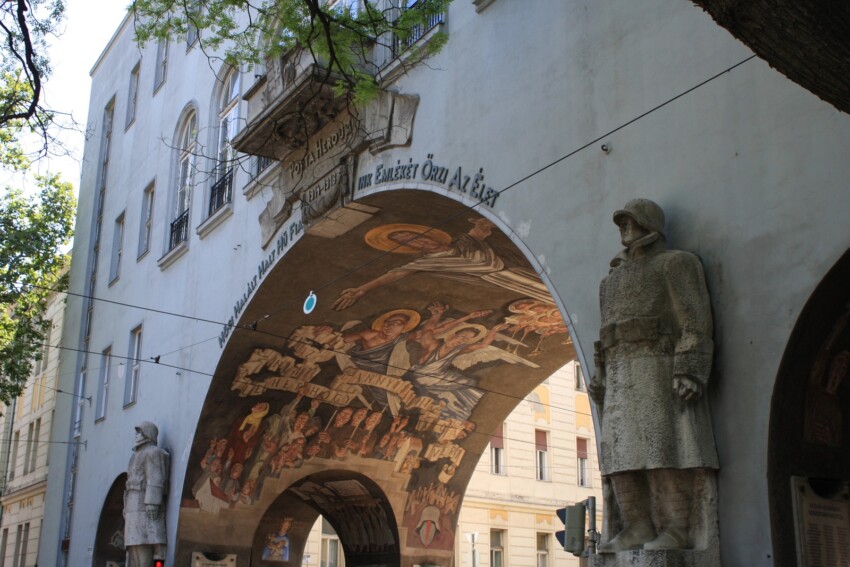
Széchenyi tér is the beating heart of Széchenyi and one of the most elegant squares in Hungary, designed after the post-flood reconstruction according to late 19th century town planning standards. At 12,000 square metres, the square is surrounded by historical buildings in the Eclectic and Art Nouveau styles that create a harmonious architectural ensemble. In the centre stands the 54-metre-high Clock Tower, the only building to have survived the 1879 flood and dating from 1370, which serves as a symbol of the city’s historical continuity.
On the northern side of the square stands the Town Hall, an imposing eclectic building constructed between 1883 and 1885, featuring a façade richly decorated with allegorical statues and an astronomical clock. Every day at noon, the clock’s mechanical figures come alive, recreating scenes from city life as the bells chime. The interior, which can be visited during office hours, contains beautiful frescoes and coffered ceilings decorated with floral motifs.
The eastern side is dominated by Reök Palace, considered the jewel of Hungarian Art Nouveau. Built in 1907 and designed by architect Ede Magyar, the building has an undulating façade decorated with polychrome ceramics and stylised floral motifs reminiscent of Antoni Gaudí’s style. Today it houses a modern art gallery with temporary exhibitions of contemporary Hungarian and international artists.
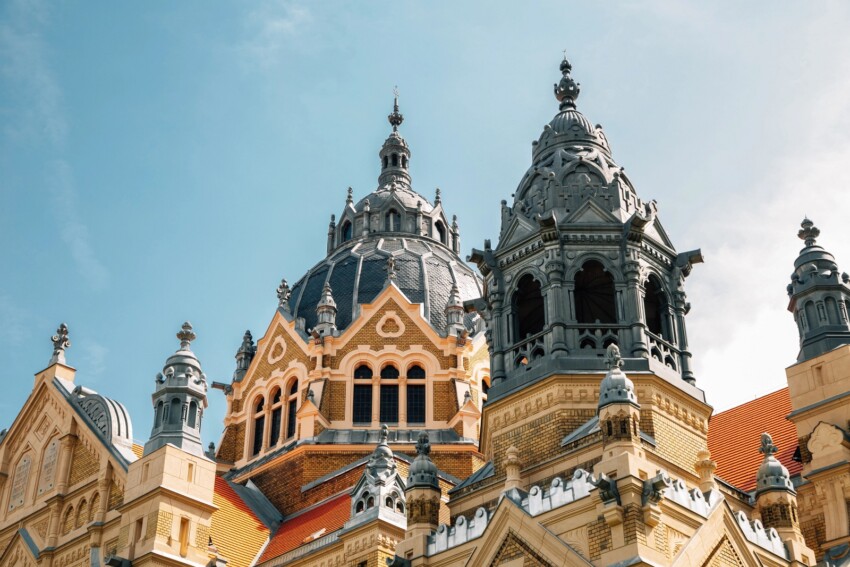
The Zsinagóga in Szeged is the fourth largest synagogue in the world in terms of capacity and is a masterpiece of European eclectic architecture. Built between 1900 and 1903 by the flourishing Jewish community of over 7,000 members, the building blends Moorish, Gothic and Art Nouveau elements in a unique stylistic synthesis. The 48-metre-high central dome is surrounded by four octagonal turrets, giving the building an unmistakable profile visible from across the city.
The interior is decorated with an extraordinary richness: the walls are covered with polychrome majolica tiles made by the Zsolnay manufactory of Pécs, while the stained glass windows create plays of light that change throughout the day. The interior dome is frescoed with golden geometric motifs reminiscent of the Islamic decorations of the Alhambra in Granada. The prayer hall can accommodate 1,340 worshippers (850 men on the ground floor and 490 women in the upper gallery) and has a monumental organ that is still used today during concerts.
During the Second World War, Szeged’s Jewish community was decimated: in May 1944, over 6,000 Jews were deported to Auschwitz, and only a few hundred survived. In the synagogue garden is a memorial with the leaves of a metal tree on which the names of the victims are engraved. Today, the synagogue is still used by the small local Jewish community for major holiday services.
The Paprikamúzeum, located in the picturesque Lower Rock along the Tisza River, documents the history and production of the spice that has made Szeged famous throughout the world. The exhibition illustrates how chilli seeds, brought to Hungary by the Turks in the 16th century, adapted perfectly to the climate and sandy soil of the Szeged region, developing unique organoleptic characteristics. The museum preserves original tools used for growing, drying and grinding paprika from the 17th century to the present day.
An interactive section explains the eight categories of paprika recognised by the PDO denomination: from the sweetest (különleges) to the spiciest (erős), and intermediate grades. You can observe the visual differences between the varieties and, even more interestingly, take part in a guided tasting session that teaches you how to recognise the nuances of flavour. The museum also has a demonstration garden where the different varieties of peppers used for production grow from June to September.
The museum shop offers PDO-certified paprika in different grinds and spiciness, packaged in decorative jars that make excellent gastronomic souvenirs.
The Tisza riverfront stretches for more than 3 kilometres through the centre of Szeged, offering a scenic promenade connecting the main monuments of the city. The pedestrian and cycle path, inaugurated after the embankment reinforcement works completed in 2005, is lined with hundred-year-old plane trees that create natural areas of shade during the summer months. Along the way you will encounter artistic fountains, modern sculptures and benches strategically placed to enjoy the view of the river.
The highlight is the Szabadtéri Játékok (Open-air Theatre), a semicircular structure built in 1931 that can seat 6,400 spectators. With the neo-Romanesque façade of the cathedral as a natural backdrop, this theatre is one of the most impressive stages in Europe. Every summer, from the end of June to the end of August, the Szeged Theatre Festival takes place, attracting over 60,000 spectators with a programme ranging from opera to musicals, ballet to classical theatre.
The productions are of the highest quality, with elaborate sets and casts that include internationally renowned artists. The full programme is published each year in April on the official website, and tickets sell out quickly for the most popular shows. During the day, when there are no rehearsals in progress, you can visit the theatre free of charge to admire the exceptional acoustics and take photographs with the cathedral in the background.
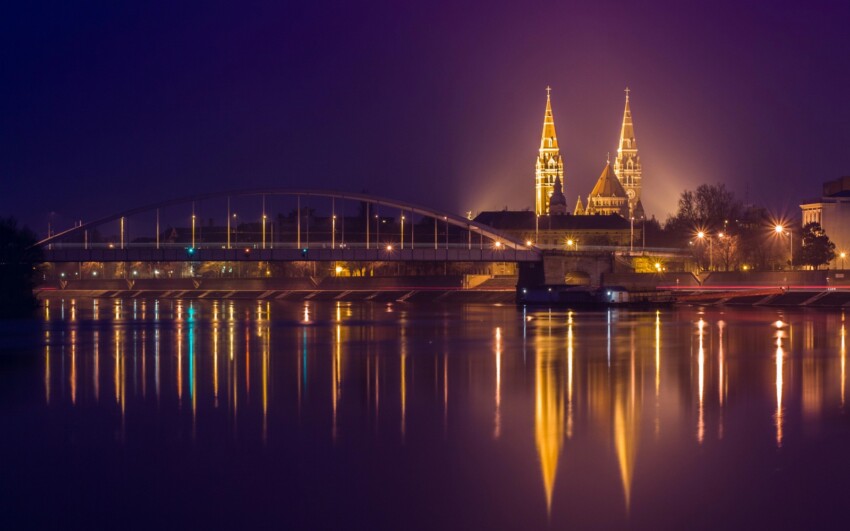
The old town offers charming hotels in renovated Art Nouveau buildings, ideal for those who wish to immerse themselves in the Central European atmosphere of the city and walk to all the main attractions. The riverfront area features modern facilities overlooking the Tisza, perfect for evening strolls and direct access to the open-air theatre during the summer festival.
The lively and well-connected university districts offer inexpensive accommodation in student-frequented residences and hostels, while the outlying residential areas provide tranquillity and competitive rates. Compared to Budapest, prices are significantly lower, with 4-star hotels available from 18,000-25,000 forints per night.
Szeged is located 172 kilometres south of Budapest and can be reached by car via the M5 motorway in the direction of Kecskemét, continuing on the same M5 to the Szeged-Nyugat exit (total time: about 2 hours). Direct trains depart from Nyugati station in Budapest on an hourly basis: the journey takes 2 hours and 30 minutes and the ticket costs 3,450 forints in second class. Some IC (InterCity) trains reduce the journey time to 2 hours and 10 minutes but require an additional 730 forints for compulsory reservation.
Car hire in Budapest also makes it easy to visit the surrounding region, including stops in the puszta (the Great Hungarian Plain) and spa towns such as Hódmezővásárhely. Volánbusz buses connect Budapest to Szeged in 2 hours and 45 minutes with departures every 2 hours from Népliget station.
What's the weather at Szeged? Below are the temperatures and the weather forecast at Szeged for the next few days.
Szeged is located in southern Hungary, in the Csongrád-Csanád region, at the confluence of the Tisza and Maros rivers, only 10 kilometres from the Serbian border. The town is 172 kilometres from Budapest and 115 kilometres from Debrecen.
 Hotel
Hotel  Budget accommodations
 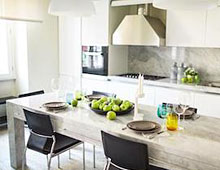 Apartments
  Family Hotel
 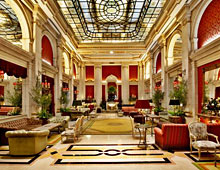 Luxury Hotel