Péterfia Panzió
Debrecen - Péterfia u. 37/b
Book now
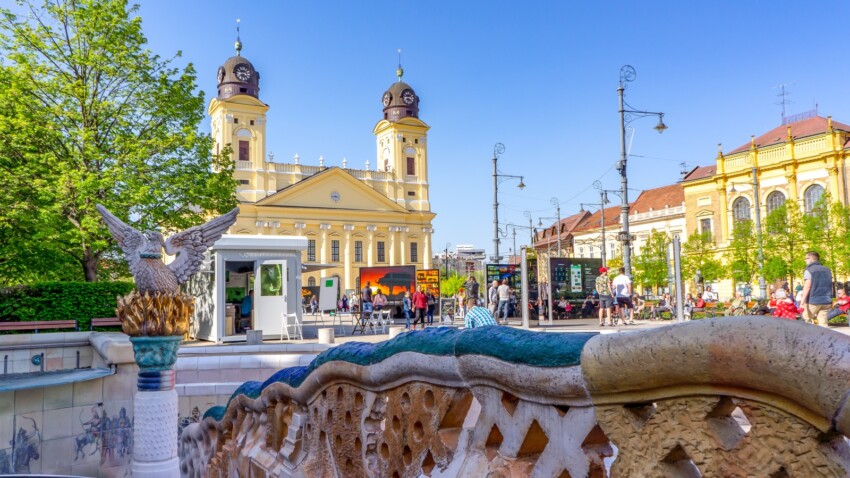
Debrecen is Hungary’s second largest city by population, with about 200,000 inhabitants, and is the main cultural, economic and religious centre of the country’s eastern region. Located on the Great Hungarian Plain, 220 kilometres from Budapest, this city has played a fundamental role in the national history, so much so that it has been nicknamed the ‘Calvinist Capital of Hungary’ due to its importance in the spread of the Protestant Reformation in Central and Eastern Europe.
The city boasts an exceptional architectural heritage ranging from Neoclassicism to Art Nouveau, with monumental buildings such as the Great Reformed Church, the undisputed symbol of Debrecen, and the majestic university complex housing one of the oldest academic institutions in the country, founded in 1538. The historical centre is built around Kossuth Square, a large pedestrian area surrounded by elegant 19th-century buildings that testify to the prosperity the city achieved in the 19th century.
In addition to its rich cultural heritage, Debrecen offers an important spa tradition with the Aquaticum complex, which combines modern wellness facilities with natural healing waters. The city is also an important university centre with over 26,000 students, giving it a lively and cosmopolitan atmosphere. The presence of the University of Debrecen attracts international students from over 100 countries, creating a multicultural environment that is reflected in city life.
Visiting Debrecen means discovering the authentic soul of eastern Hungary, off the beaten tourist track, but with a cultural, historical and gastronomic offer that deserves at least two days of in-depth exploration, ideally in combination with a stay in Budapest or as a base for exploring the Great Plain.
The city offers a concentration of historical, cultural and architectural attractions that tell centuries of Hungarian history. From its role in the Protestant Reformation to the proclamation of independence from Austria in 1849, Debrecen has always played a major role in national events. The compact and easily walkable historical centre is built around Kossuth Square and along the charming Piac utca boulevard, the commercial and social heart of the city.
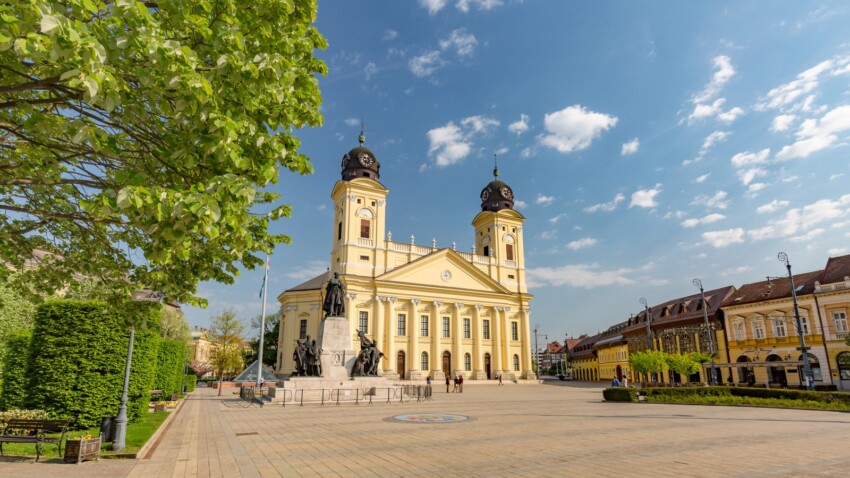
The Nagytemplom (Great Church) is the iconic symbol of Debrecen and the largest Protestant church in Hungary. Built between 1805 and 1824 in the Neoclassical style to a design by architect Mihály Péchy, the building dominates Kossuth Square with its imposing façade featuring a portico with six Doric columns and twin 61-metre high bell towers. The church replaced an earlier medieval building destroyed by a devastating fire in 1802 that razed much of the town centre to the ground.
The interior can accommodate up to 3,000 worshippers and is remarkable for its Protestant austerity, devoid of the Baroque decoration typical of Hungarian Catholic churches. The highlight is the majestic organ, built in 1838 by the Swiss firm Moser, which has 4,850 pipes and is considered one of the most valuable instruments in Central Europe. The simple but elegant interior decoration includes a neoclassical pulpit and perfectly preserved oak pews.
The church is of great historical importance: here, on 14 April 1849, the Hungarian Parliament led by Lajos Kossuth proclaimed the deposition of the Habsburg dynasty and the independence of Hungary during the revolution of 1848-49. This event is commemorated by a plaque inside the building. The Great Church is open to visitors Monday to Saturday from 10 a.m. to 4 p.m. and on Sundays from 12 noon to 4 p.m. Admission costs 800 guilders and includes the possibility of climbing one of the bell towers (97 steps) to enjoy an exceptional view of the city and the surrounding plain.
The Debreceni Református Kollégium is one of Hungary’s oldest and most prestigious educational institutions, founded in 1538 and still operating today as a secondary school. The present neoclassical building was completed in 1816, replacing the previous structures destroyed by fire in 1802. With its 160-metre-long façade and characteristic yellow ochre colour, the College is one of the most impressive buildings in the old town.
The complex houses several themed museums of great interest. The Historical Library holds over 600,000 volumes, including incunabula from the 15th century and the most important collection of Protestant Reformation works in Hungary. Especially valuable is the Debrecen Bible, the first complete translation of the Holy Scriptures into the Hungarian language, printed here in 1590. The Museum of the History of Education illustrates the evolution of the Hungarian school system through perfectly preserved historical classrooms, complete with original 19th-century furniture.
The Great Hall of the College was the seat of the revolutionary parliament in 1849 and still retains the atmosphere of those crucial days in Hungarian history. During the tour you can see the chair from which Kossuth delivered his most famous speeches and various relics from the period. The museum complex is open Tuesday to Sunday from 10 a.m. to 5 p.m., with an entrance fee of 1,800 forints, which includes access to all exhibitions. Guided tours in English are available by appointment and strongly recommended to fully understand the historical importance of the institution.
The Déri Múzeum is the main museum in Debrecen and one of the most important in eastern Hungary. Founded in 1902 thanks to a donation from the wealthy merchant and collector Ferenc Déri, the museum occupies an elegant eclectic building on Déri Square, characterised by a monumental façade decorated with allegorical sculptures representing the arts and sciences.
The permanent collection ranges from archaeology to contemporary art, with an emphasis on the local history and culture of the Great Plain. The archaeological section displays exhibits covering a time span from prehistoric to medieval times, including Scythian gold treasures from the 4th century B.C. found in the region. Also of great interest is the ethnographic collection documenting Hungarian rural life through traditional costumes, agricultural tools and reconstructions of peasant interiors.
The jewel in the museum’s crown is the Trilogy of Christ by Hungarian painter Mihály Munkácsy, considered one of the most important works of 19th-century Hungarian art. The three huge paintings – ‘Christ before Pilate’ (1881), ‘Golgotha’ (1884) and ‘Ecce Homo’ (1896) – occupy an entire room specially designed with dramatic lighting. It took Munkácsy years to complete these monumental works that combine academic realism and emotional drama. The museum also hosts temporary exhibitions of contemporary art and organises cultural events throughout the year. Opening hours are Tuesday to Sunday from 10 a.m. to 6 p.m., with an entrance fee of 2,200 forints (reduced 1,100 forints for students and pensioners).
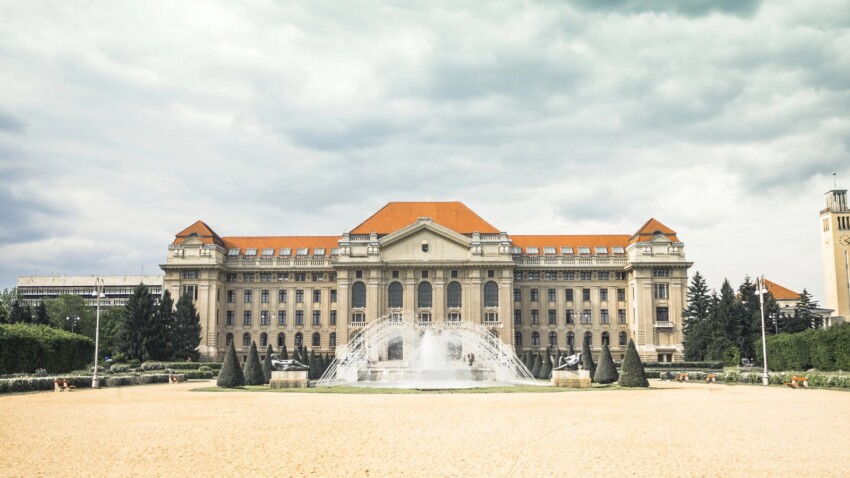
The Nagyerdő (Great Forest) is Debrecen’s green lung, a 2,300 hectare wooded area north of the city centre that can be reached in 15 minutes by tram number 1. This centuries-old park offers an oasis of tranquillity with tree-lined avenues, ponds, meadows and a dense vegetation of oak, beech and maple trees that provide shade during the hot summer months of the Hungarian lowlands.
Within the park are several attractions of interest. The Botanical Garden of the University of Debrecen covers 12 hectares and is home to more than 6,000 plant species from all over the world, with greenhouses dedicated to tropical and exotic plants. Admission costs 600 forints and is open from April to October from 9 a.m. to 6 p.m. Debrecen Zoo, opened in 1958, covers 30 hectares and is home to around 1,500 animals of 250 different species, with a focus on Hungarian fauna and steppe animals. The zoo is open all year round, with opening times varying according to the season (ticket: 2,900 forints adults, 2,100 forints children).
For sports enthusiasts, the park offers cycling and jogging trails and an artificial lake where rowing is possible during the summer. In winter, when the lake freezes over, it becomes a natural skating rink popular with locals. The park is also home to the Aquaticum spa complex and several kiosks where Hungarian specialities such as lángos (fried flatbread) or kürtőskalács (cylinder-shaped cake baked on the grill) can be tasted.
The Aquaticum is Debrecen’s modern thermal and aquatic complex, located in Nagyerdő Park. Opened in 2003 and expanded in 2013, it represents one of the most advanced wellness facilities in eastern Hungary, combining traditional curative spas with modern aquatic attractions. The thermal water gushes out from a depth of 1,100 metres at a temperature of 63 degrees Celsius and is particularly rich in calcium, magnesium, iodine and bromine, with recognised therapeutic properties for rheumatic disorders and dermatological problems.
The complex is divided into two main sections: the indoor Mediterranean area, open year-round, with thermal pools at temperatures between 32 and 38 degrees Celsius, saunas, steam baths and a wellness area with spa treatments; and the outdoor summer adventure area, with wave pools, water slides up to 272 metres long, a lazy river and children’s areas. The spa section includes 10 different pools, while the outdoor area has 11 more during the summer season (May-September).
Particularly popular are the themed saunas: the 90-degree Finnish sauna, the steam bath with aromatherapy, the herbal sauna and the ice experience with artificial snow at -15 degrees for thermal contrast. The complex also offers professional wellness treatments, therapeutic massages and physiotherapy programmes. Prices vary according to season and duration: a one-day ticket for the Mediterranean area costs 4,600 forints on weekdays and 5,100 at weekends, while full access to both areas in the summer comes to 6,900 forints. The Aquaticum is open daily from 9 a.m. to 9 p.m., with extended hours on weekends until 10 p.m. It is advisable to compare the experience with Budapest’s historical baths, which offer a more traditional atmosphere.
The historical centre around Kossuth Square is the most convenient area for visitors, with hotels ranging from budget to luxury, many of them in restored historical buildings. Staying here means being within walking distance of the Great Church and major museums, as well as having immediate access to the many restaurants and cafés of Piac utca. The university area, east of the centre, offers budget accommodation such as hostels and student flats, ideal for young travellers on a budget. The Nagyerdő Park area is perfect for those seeking tranquillity and proximity to the spa, with modern hotels offering wellness packages. Prices are generally lower than in Budapest, with excellent value for money especially in family-run guesthouses.
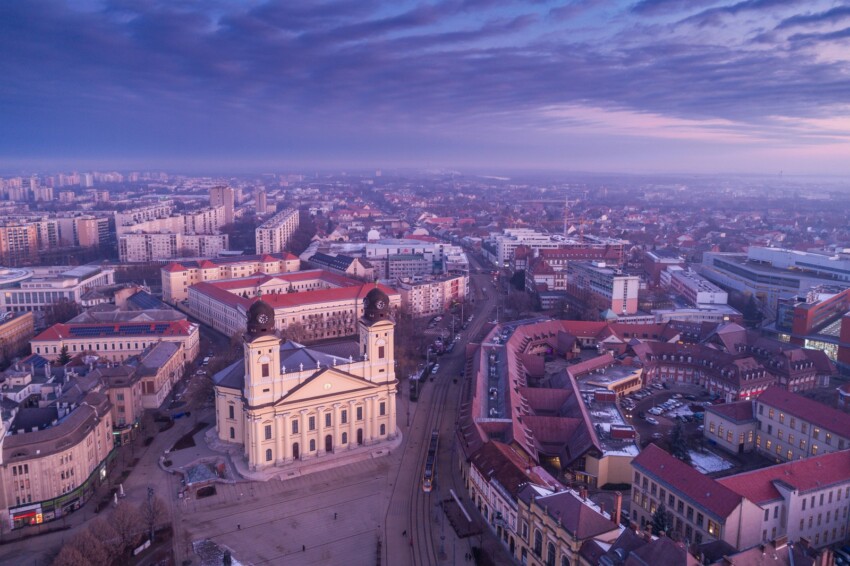
From Budapest, Debrecen is 220 kilometres away and can be reached by car via the M3 motorway to its end (total time: about 2 hours 15 minutes). The motorway is toll-free and requires the purchase of a Hungarian electronic vignette. Alternatively, the train is a very convenient option with direct trips leaving from Keleti station every hour. The fastest InterCity trains take 2 hours and 15 minutes, while regional trains take about 3 hours. Tickets cost 5,730 forints in second class and 7,650 in first for InterCity.
For those who prefer autonomy, car rental in Budapest also allows you to comfortably explore the Hungarian Great Plain region. Debrecen also has an international airport located 5 kilometres from the centre, with direct connections to several European cities, mainly served by low-cost airlines and charter flights. Direct buses from Budapest leave from Népliget station at a frequency of about one every hour and take 3 hours and 15 minutes.
What's the weather at Debrecen? Below are the temperatures and the weather forecast at Debrecen for the next few days.
Debrecen is located in the Hajdú-Bihar region, in eastern Hungary, in the heart of the Great Hungarian Plain (Alföld). The city is 220 kilometres from Budapest, 30 kilometres from the Romanian border and 50 kilometres from Ukraine.
 Hotel
Hotel  Budget accommodations
  Apartments
 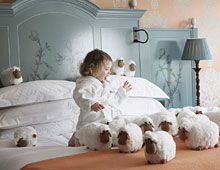 Family Hotel
 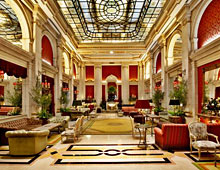 Luxury Hotel